
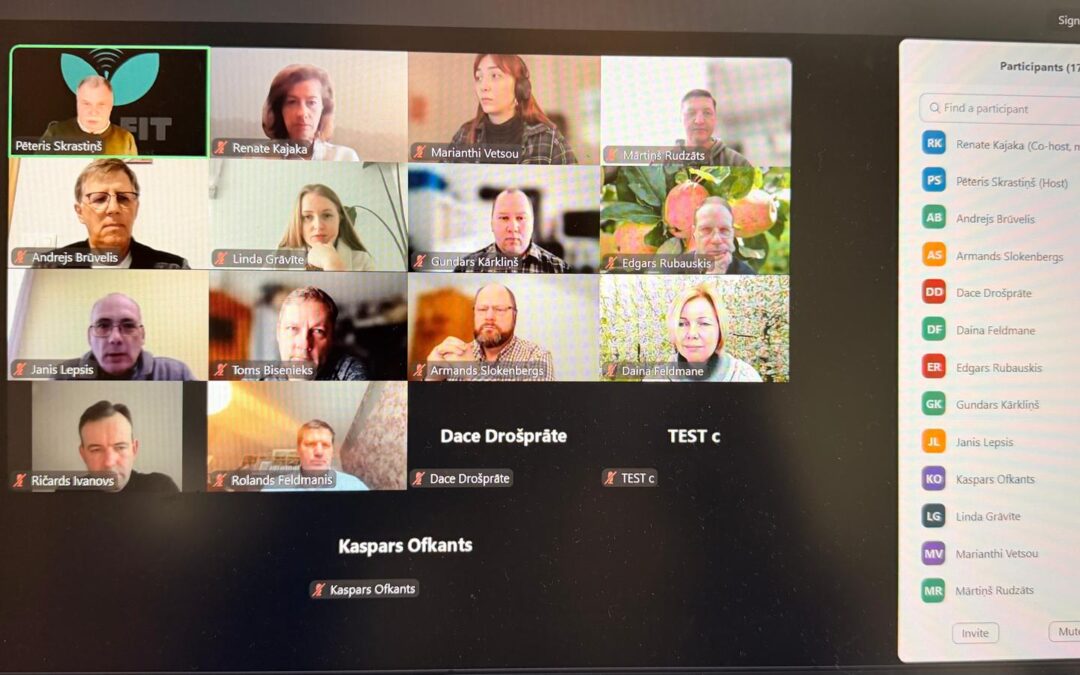
On 13 February 2026, Latvijas Augļkopju Asociācija (LAA), organised an online focus group to explore what encourages, and what prevents farmers from adopting green and digital technologies in Latvia.
The discussion brought together 15 participants, including farmers, advisors, cooperatives, policymakers, technology providers and scientists. Through active debate and poll questions, stakeholders shared practical field-based insights.
How Familiar Are Stakeholders with Green and Digital Technologies?
Most participants (75%) reported being quite familiar with green and digital technologies, although they use them only to a limited extent. The remaining 25% are somewhat familiar but lack practical experience. This indicates that awareness is not the main issue, but the real challenge is moving from knowledge to broader implementation.

Main Identified Barriers to Adoption
The three key barriers identified were financial and economic, technical, and regulatory. High costs and the risk of financial losses are the most significant concerns. Many farmers stated they would adopt smart and green technologies if financial support were available, even if immediate financial returns are uncertain. In addition, previous experiences with underperforming technologies have reduced trust and slowed adoption.
Most Important Incentives
Participants highlighted three major incentives that could drive change:
- Financial support from governmental institutions for purchasing green and smart technologies, especially when adoption is linked to green policy requirements.
- Proven and reliable technologies that clearly deliver a return on investment. Developers must ensure solutions are well-tested and economically justified.
- Good examples of use in real farming, demonstrating clear and practical benefits.
Conclusion
Overall, participants expressed a positive attitude towards green and smart technologies. Farmers recognise that climate change directly affects agriculture, and climate-friendly practices are part of the solution. However, successful adoption requires technologies that are farmer-friendly, economically viable, and properly tested before entering the market. Stronger state and EU-level support is expected to facilitate the transition from conventional to smart farming.
Regulatory updates are essential, as many rules still reflect outdated methods and limit modern technologies. Improving regulations would support innovation and wider adoption of green and digital solutions in Latvian agriculture.