
On 24 February 2026, our Romanian partner, the Forumul Agricultorilor și Procesatorilor Profesioniști din România (FAPPR), a federative organisation representing farmers and primary processors, conducted an online focus group in Romania with 12 participants representing farmers, advisors, cooperatives, and technology providers.
The session explored barriers, incentives, and behavioural factors influencing the adoption of digital and precision agriculture technologies in Romanian farming.
Familiarity with Digital Technologies
Participants indicated that digitalisation is already present in Romanian agriculture, particularly through GPS systems and basic precision tools. This means that the challenge is not awareness but rather scaling and deepening adoption. Stakeholders were generally familiar with technologies, but adoption is often limited by economic and technical constraints.
Main Identified Barriers to Adoption
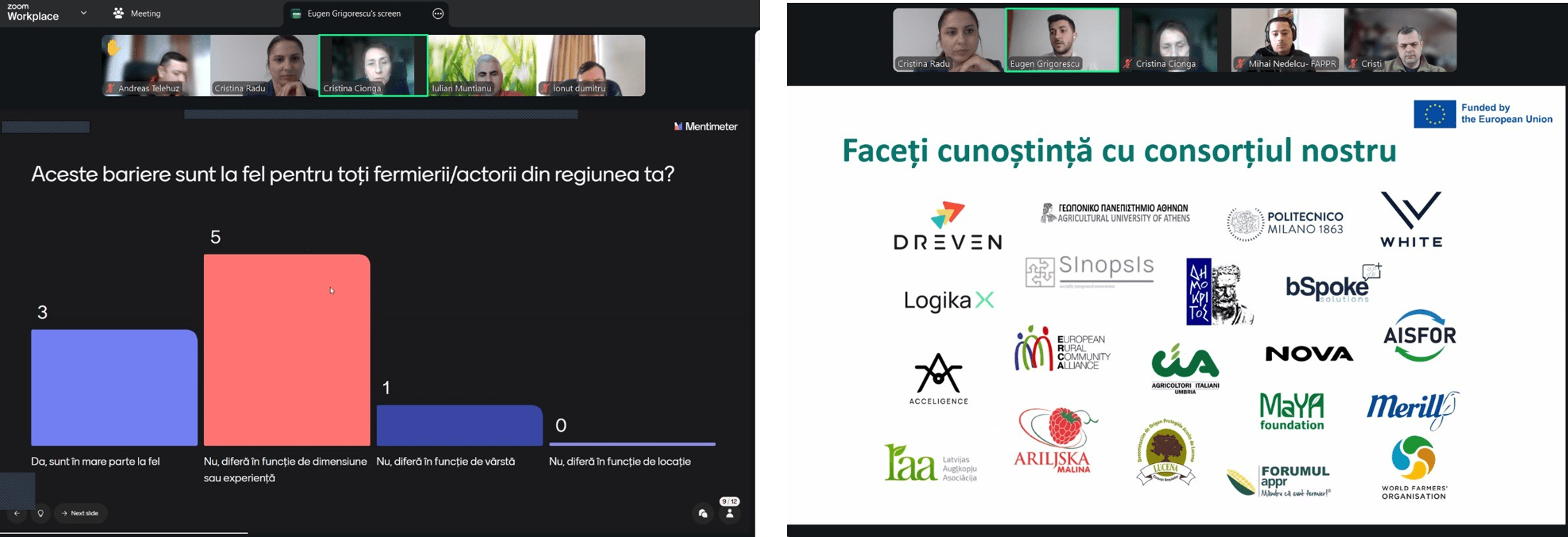
The discussion highlighted several structural, economic, and behavioural barriers. High investment costs and financial risk were key concerns, with farmers expressing caution in adopting new technologies when economic returns are uncertain. Participants also noted a lack of reliable technical support, as uncertainty about maintenance and long-term assistance reduces trust in digital systems. Poor interoperability between existing and new technologies further hinders integration and discourages adoption. Even when interest in digitalisation exists, uptake is often blocked by financial risk, uncertainty regarding system performance, and the absence of trusted support services.
Key Incentives for Adoption
Stakeholders highlighted several practical incentives that could accelerate uptake. Lower costs and reduced financial risk were seen as essential, alongside real-life demonstrations of technology on local farms, which help build confidence and trust. Long-term, guaranteed technical support and simplified administrative procedures were also considered critical to encourage adoption. Peer validation, observing successful results in similar farm contexts, further reinforces willingness to adopt. Overall, adoption decisions were described as pragmatic and economically driven, with proven ROI, tangible demonstrations, peer experiences, and clarity on long-term costs emerging as the most influential factors.
Conclusion
Overall, Romanian farmers and stakeholders maintain a positive yet cautious attitude toward digital and precision agriculture. Financial risk continues to be the main barrier to digital adoption among Romanian farmers, while interoperability and technical reliability remain essential for building trust. Farmers tend to prioritize economic survival over environmental goals, underscoring the need for practical, financially beneficial solutions.
Adoption is most effectively driven by demonstration-based learning and peer exchange, suggesting that decision-support platforms should integrate seamlessly with existing farm data and clearly demonstrate measurable economic advantages. Addressing these factors holistically can accelerate the uptake of digital agriculture solutions in Romania.